API Throttling Techniques That Keep Web Apps Running Smoothly During Peak User Loads
Hugo Fischer · Oct 5, 2026

API Throttling Techniques That Keep Web Apps Running Smoothly During Peak User Loads
Web applications face increasing demands as user bases expand, and API throttling serves as a core mechanism that regulates incoming requests to maintain system stability when loads surge. Developers apply these controls so that servers process traffic without crashing under sudden spikes, and organizations report measurable improvements in uptime metrics after deployment. Research indicates that effective throttling reduces error rates by distributing requests evenly across available resources, while data from industry reports shows consistent performance gains in production environments worldwide.
Core Principles Behind Request Regulation
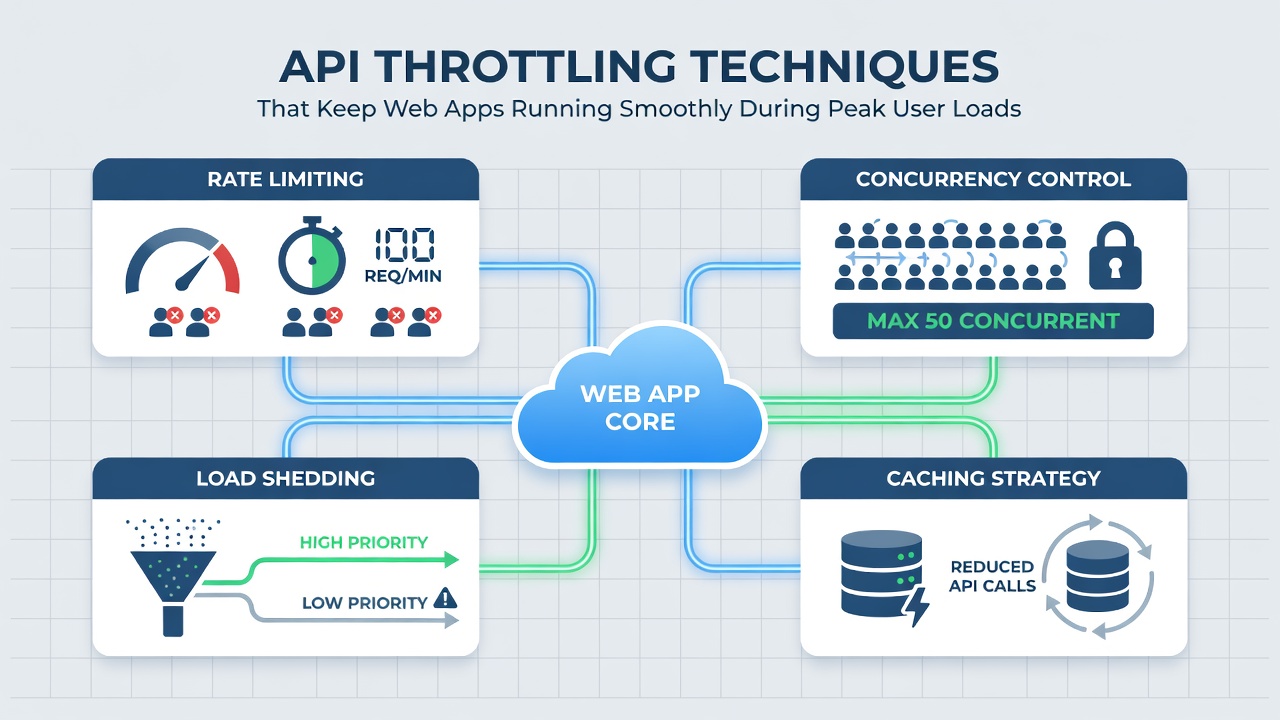
Throttling operates by setting limits on the number of API calls a client or application can make within a defined time window, and this approach prevents any single source from monopolizing backend capacity. Observers note that systems often combine multiple algorithms to handle different traffic patterns, since simple fixed limits alone fail to account for bursty behavior common in real-world usage. Those who've studied large-scale deployments find that monitoring tools track request rates in real time, allowing automatic adjustments when thresholds approach critical levels.
Engineers typically measure success through latency averages and successful response percentages, and figures reveal that well-tuned setups keep response times under acceptable bounds even during events like product launches or seasonal promotions. The reality is that without these safeguards, databases and compute layers experience queue buildup that leads to cascading failures across dependent services.
Token Bucket Method for Handling Variable Traffic
One widely adopted technique uses the token bucket algorithm, where a conceptual bucket accumulates tokens at a steady rate and each incoming request consumes one token before proceeding. Applications grant access only when sufficient tokens exist, which permits short bursts above the average rate while enforcing long-term limits through token depletion. Experts have observed that this method suits APIs with unpredictable usage spikes because it balances flexibility against resource protection, and studies from academic sources confirm its efficiency in cloud-native architectures.
Leaky Bucket for Steady Output Control
The leaky bucket variant processes requests at a constant rate regardless of arrival patterns, and excess requests queue or drop once the bucket overflows. This creates predictable output flows that downstream systems can handle without overload, and data shows reduced variance in processing times compared to unregulated streams. People often find this approach useful in scenarios involving queued tasks or payment processing endpoints where order matters more than speed.
Sliding Window and Fixed Window Variants
Sliding window counters track requests over a moving time interval that resets partially with each new period, which avoids the sharp resets seen in fixed window implementations. Fixed windows divide time into discrete blocks and reset counts at block boundaries, yet they sometimes allow bursts at the edges of those blocks. Researchers discovered through comparative testing that sliding approaches deliver smoother distribution, although they require more computational overhead to maintain accurate counters across distributed nodes.
Organizations deploy these variants based on their infrastructure scale, and those managing global services often layer regional limits on top of global ones to account for time zone differences in user activity. According to Statistics Canada reports on digital infrastructure usage, peak loads in North American systems frequently align with evening hours across multiple zones, making adaptive windows essential for consistent delivery.
Distributed System Challenges and Solutions
When applications run across multiple servers, maintaining accurate throttling state requires coordination through shared caches or consensus protocols, and this adds complexity that teams address with tools like Redis for counter storage. Observers note that eventual consistency models sometimes permit slight overages, yet the trade-off remains acceptable when full synchronization would introduce unacceptable delays. There's this case where experts found that combining client-side rate hints with server enforcement reduced unnecessary calls before they reached the network layer.
Implementation often involves headers that communicate current limits and remaining allowances back to clients, allowing applications to back off gracefully rather than retry aggressively. Data indicates that such feedback loops cut retry storms during recovery phases, and similar patterns appear in reports from European digital services monitoring.
Integration With Authentication and Monitoring Layers
Throttling frequently ties into authentication systems so that limits apply per user, per IP, or per API key depending on the use case, and this granularity prevents abuse while preserving fair access for legitimate traffic. Teams configure alerts that trigger when utilization crosses warning thresholds, enabling proactive scaling before hard limits engage. What's interesting is how these integrations surface usage analytics that inform capacity planning decisions over longer periods.
One study revealed that organizations combining throttling data with predictive models achieved better resource allocation during known high-demand windows, and the approach extends to containerized environments where auto-scaling groups respond to sustained pressure signals.
Conclusion
API throttling techniques continue to evolve alongside application architectures, and evidence suggests their role grows more critical as services handle larger concurrent user volumes. Teams that map specific traffic characteristics to appropriate algorithms see sustained reliability, while distributed implementations require careful attention to state management across nodes. The ball's in the court of system architects to select combinations that match their operational constraints, and ongoing measurement ensures adjustments keep pace with changing demand patterns.